

EXTEND LIFE-CYCLE FOR LEGACY SYSTEMS
Server-based applications are often still necessary. We enable you to easily integrate your ‘old world’ systems into the new world and ensure they remain relevant
Cloud migration 100% complete? No? Then you need a platform that helps you rapidly connect server-less applications with server-based data sources

Hybrid cloud integration is a strategy to bridge the gap between the existing on-premises systems such as databases, legacy applications and warehouses, and SaaS technologies as well as multicloud environments.
Cloud and SaaS are undoubtedly the key elements of any company's digital transformation; large amounts of data are processed and consumed through this path. Yet some data have to remain "on the ground", whether due to regulatory or data protection requirements, or just being business-critical data remnants in not-yet-updated systems.
Hybrid cloud integration provides a way to make these data accessible (again) on a higher level, allowing to effectively use it together with data from serverless applications for better-informed decisions, more accurate analysis, and mission-critical operations.
The evolution of companies from server-based to server-less is often accompanied by evolutions in the skill sets of their employees. Not only do they need to know how to connect APIs to "the ground", but also how to establish secure connections between diverse applications, databases and services, handle the growing amount of integration flows, and of course, maintain the daily operations.
A hybrid integration platform provides organizations with all the necessary tools to support a wide range of hybrid integration scenarios and make data integration between on-premise and cloud environments easier and simpler.
The elastic.io iPaaS has multiple modes of use – starting with non-technical citizen integrators and escalating through low-code click-‘n-drop data transformers, to integrators and developers who look to automate complex processes with powerful JSONata strings. Regardless of your skill level and automation goals, our User Interface and open API have functions that will boost your productivity.
Server-based applications are often still necessary. We enable you to easily integrate your ‘old world’ systems into the new world and ensure they remain relevant
Implement hybrid integration projects up to 10-times faster than with traditional coding. Manage and troubleshoot all your integrations within a single dashboard
Setup user rights in accordance with PoLP for Users and Workspaces. Our encryption of all payload data in transit ensures your data is not vulnerable to breaches
elastic.io enabled us to migrate the existing customer base from one system to Salesforce and Exponea without the need to have a heavy switch over. It was more like a smooth switch because we were able to listen on updates/deletes.
Christian Droege
Senior Software Architect, Krombacher
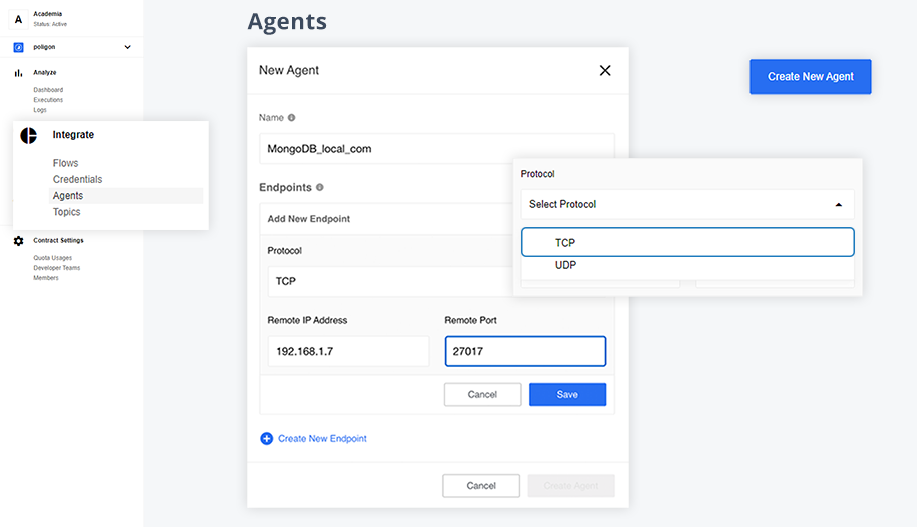
The VPN Agent is а secure VPN tunnel specifically created to access any resource in your local environment, such as your internal database or an on-prem enterprise CRM system. Our platform uses the VPN Agent to communicate data to and from your local data source safely and securely.
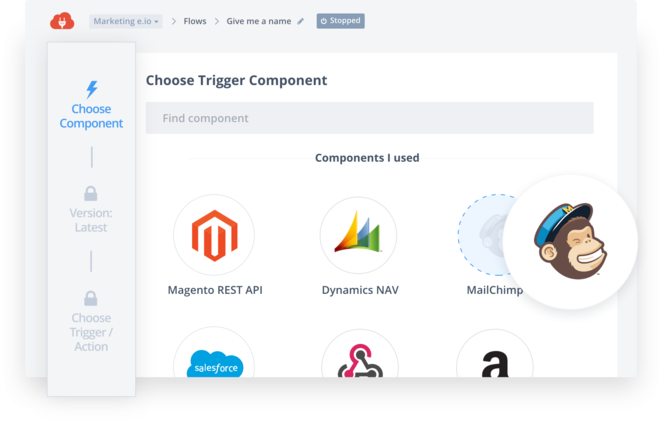
No matter what your level of expertise is, our library of 100+ predefined application connectors and standardized components will accelerate hybrid integration initiatives. Many connectors are open-source and can be easily modified using our SDK
All data are accessible in JSON format and can be transformed, enriched, arrayed, and tested using the powerful query and transformation language JSONata. In the event of complex integration scenarios, our Content-based Router, Splitter and Filter help ensure efficient processing of data and enable custom integration logic.
Explore the elastic.io Enterprise Integration Platform >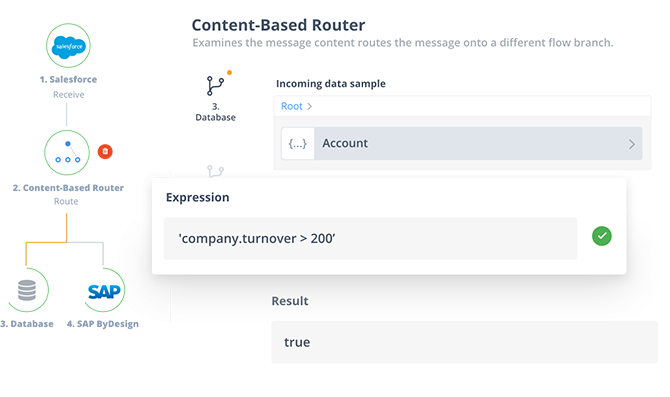




While the cloud is undoubtedly the future of IT and innovation, the transition won't happen overnight and will probably never be full. Replacing legacy systems is a long process and some data is simply better off on-premises. Yet a proper strategy is still needed to connect various environments to ensure high operability, efficient information exchange, and smooth operations. This is where the hybrid cloud approach comes into play. And in the context of hybrid integration it means that a reliable data synchronization needs to be ensured between all elements of a company's hybrid cloud architecture.
First things first – what is hybrid cloud architecture? To put it simply, it is a mixture of on- and off-premises environments. Now, sometimes you'd find that a private cloud is equated with on-premises, but this is not entirely correct. A private cloud is a cloud dedicated solely to one business entity or one organization; however, it can be hosted on- as well as off-premises. So, for the sake of our question, it would be more correct to say that hybrid cloud architecture encompasses various cloud environments (public and private) and traditional data center infrastructure.
As for the hybrid integration architecture, now that we established what hybrid cloud "consists" of, it's easy to see that when it comes to hybrid integration, it's basically the same concept. The whole point of various environments being connected is that data can move freely between them. In reality, though, you must also factor in not only your own environments, but also partners environments, too. This is why you need to outline a proper hybrid integration strategy right from the start.
Short answer: with a mix of tools and strategies that create a reliable and secure data flow between on-prem and clouds – whether local, dedicated, or public. These can include: interaction, partner and/or system APIs; a secure gateway to connect to your local environment (elastic.io uses a VPN Tunnel for this purpose); a B2B gateway to simplify EDI (electronic data interchange) handling; a versatile validation strategy that will span over access tokens, application IDs and various authentication methods.
There are so many solutions and products on the market that support hybrid cloud integration efforts: IBM, Talend, WSO2 are just a (very) few examples. So, how do you evaluate a hybrid integration solution and what capabilities are must-have?
Let's consider briefly, what such a solution must be able to do on a technical level: As stated above, it needs to provide a secure gateway (such as our VPN Agent) to enable data flow between the local environment and the cloud. It should support a variety of protocols such as EDI or XML for enterprise-grade use cases such as B2B or even IoT, for that matter. Obviously, you also need a variety of patterns and strategies to interconnect applications – from messaging to process orchestration (and, of course, APIs). Ideally, you'll have pre-built connectors for mainstream service and applications stack for low- or no-code integration as well as ways to build API-led connectivity for REST and SOAP for home-grown services and apps. Last but not least, to limit the amount of point-to-point integrations, you'll need a pub/sub architecture to enable systems to respond to events in near real-time and with low latency.
As for the usability aspect, ideally, a hybrid integration platform should provide as much standardization and automation as possible, with drag-n-drops, intuitive mapping, and user-friendly interface. Even though it is not to expect that line-of-business employees will take part in the process (as much as some experts want us to convince), the benefits of a low-code hybrid integration platform should not be reserved to only a handful of specifically trained IT specialists but ideally, to any IT department member, regardless of their skill level.

